EagleView
Precision Bidding with EagleView and LoadBearing CRM
LoadBearing Editorial · · 6 min read
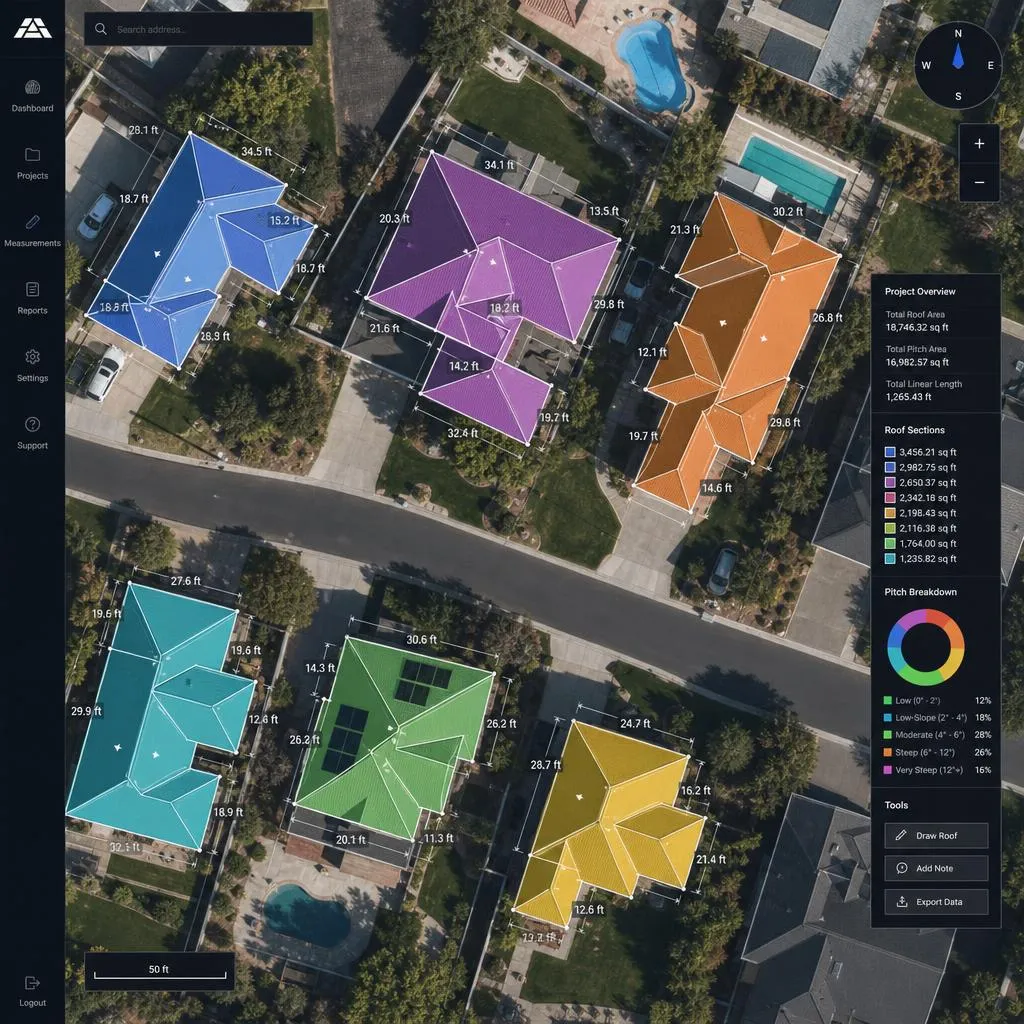
The traditional method of pulling a ladder off the truck, climbing a steep pitch, and stretching a tape measure across a roof valley is rapidly becoming obsolete. In a high-volume roofing business, manual measurements are a bottleneck that costs you time, accuracy, and safety.
How much does a measurement error cost on a roof bid?
A small measurement error can erase the profit on a residential roof, because materials, labor and waste all scale with the square count.
Underestimating a roof by just two squares can entirely wipe out the profit margin on a residential job. Overestimating makes your bid uncompetitive. Precision is non-negotiable. EagleView has revolutionized the industry by providing highly accurate, satellite-derived measurements of pitch, square footage, ridges, and valleys.
However, raw data is only useful if it can be quickly translated into a customer-facing proposal.
How do aerial measurements become an estimate?
The measured totals, such as squares, ridge, hip, valley, eave and rake lengths, become the quantities on your estimate template lines.
LoadBearing CRM bridges the gap between raw measurement data and the final contract. When a sales representative pulls an EagleView report, the data—total squares, linear feet of drip edge, ridge lengths—can be directly incorporated into the LoadBearing estimating engine.
This eliminates the tedious process of manual data entry. The estimator simply builds their proposal using the exact measurements provided, ensuring the resulting materials and labor calculations are bulletproof.
Winning at the Kitchen Table
Homeowners are impressed by professionalism. Presenting a hand-scribbled quote on a carbon-copy pad does not inspire confidence. Presenting a digital, itemized proposal that incorporates exact satellite measurements does.
With LoadBearing CRM, your sales team can generate a flawless, highly detailed proposal while sitting at the homeowner's kitchen table. The transparency of the data builds trust, and the speed of the presentation closes the deal. The client can approve the estimate via the Client Portal on the spot, allowing your company to move the job straight into the production calendar.
A hypothetical two-square miss
This example uses invented, round-ish prices for clarity, not market data. Say your installed price on a simple re-roof works out to $520 per square, with a 12 percent margin. On a 30-square roof that is $15,600 in revenue and about $1,870 in margin. If the roof is actually 32 squares, the extra materials and labor for two squares cost roughly $920 at your rates, and you also miss the matching ridge and starter. Half the margin is gone before any surprise on the deck.
When should you still climb the roof?
You should still inspect in person when you need to judge condition, not just size. A measurement report tells you how much roof there is; it does not tell you about soft decking, layers of old shingles, failed flashing or ventilation problems. Use the report to price quantity and the inspection to price conditions.
Limits and edge cases of aerial measurements
- Recent additions or tree cover can make imagery out of date or hard to read. Compare the report against what you see on site.
- Low-slope sections and complex dormers are where most discrepancies appear. Check them first.
- Waste factor is your decision, not the report's. Hip roofs and cut-up designs need more waste than simple gables.
- A report from one provider may not match another. Pick one source per job and note which you used on the estimate.
Measurement data shortens the path from inspection to proposal, but the proposal is still yours. Treat the report as a strong starting quantity and your inspection as the correction.
Which measurements matter most on a roof estimate?
Total squares drive shingles, underlayment and most labor, but linear measurements decide the accessories that are easy to under-order. Ridge and hip length set ridge cap; eave length sets starter strip and drip edge on the eaves; rake length sets drip edge on the gables; valley length sets valley metal or ice and water membrane. Pitch changes labor and safety requirements, and steep sections often carry a separate labor line. Building templates with lines for each of these keeps an estimator from forgetting the small items that add up.
A practical habit is to keep one template per common roof type in your area, with the waste factor and accessory lines pre-filled, then edit quantities from the measurement report for each job. The estimator spends time on the conditions found during the inspection instead of retyping the same twenty lines.
Does faster bidding change how homeowners decide?
It often changes who gets the first serious conversation. A homeowner comparing several contractors tends to remember the one who explained the scope clearly with numbers they could check. Showing the measured quantities on the proposal, and explaining what each line covers, invites questions you can answer at the table instead of after a competitor has already visited. Speed helps only if the proposal is also accurate and understandable; a fast estimate that changes later costs more trust than it earns.
Finally, keep the measurement report attached to the job. If quantities are questioned later, by the homeowner, a supplier or an adjuster, you can show exactly what the bid was based on.
Filed under Insurance Claims, Storm and Roofing, Estimating and Invoicing
Related field notes
- Surviving Storm Work: Cash Flow and CRM Features for Roofers · Roofing
- Documenting Wind and Hail Claims: A Blueprint for Approvals · Insurance Claims
- The End-to-End Workflow: From Lead to Final Payment in LoadBearing CRM · CRM Features
- Scaling Specialized Construction: Operations Beyond General Contracting · Construction
Ready to stop letting jobs fall through the cracks? Start a 14-day free trial.